
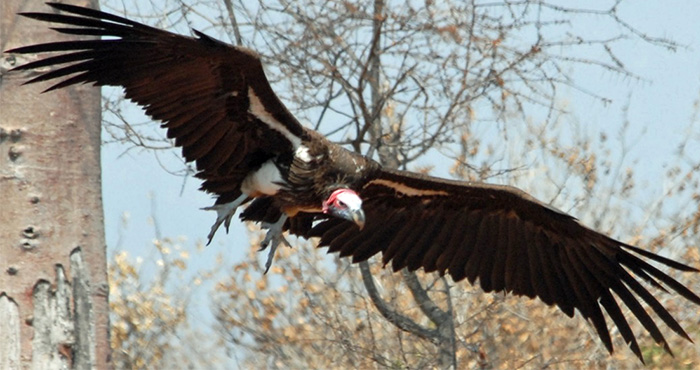
Asheboro, N.C. – The National Geographic Society’s Conservation Trust Advisory Board has awarded the North Carolina Zoo’s Dr. Corinne Kendall a $20,000 grant in support of her project "Protecting Tanzania’s Endangered Vultures: Understanding their Movement and Creation of a Long-term Monitoring Program." The Associate Curator of Conservation and Research at the North Carolina Zoo, Dr. Kendall oversees zoo-based research and is involved in several international conservation projects run by the zoo. Dr. Kendall has been studying vultures in East Africa for over eight years. Her work at North Carolina Zoo is allowing her to make a global difference for wildlife.
Vultures are currently the fastest declining group of birds globally and recent work has led to several African vulture species being up-listed to Critically Endangered. The primary threat to vultures is poisoning. People put poison, often in the form of pesticides, on carcasses or dead animals trying to kill lions and hyenas, which occasionally kill their livestock. Over 100 vultures can be killed at just one carcass, so the impact of this activity has been enormous.
Sadly, the loss of vultures can have severe economic and ecological implications. As the undertakers of the animal kingdom, vultures play a critical role in decomposition and disease control. Loss of vultures in India led to an explosion in feral dog populations, which was accompanied by rapid spread of rabies in dog and human populations. The estimated toll of the Asian vulture decline is $34 billion over 10 years.
In addition to healthcare costs, loss of vultures in Africa could have important implications for the tourism industry given the likely rise in rotting carcasses that would exist due to their demise causing an unpleasant nuisance to tourists. Vultures can also be a ranger’s best friend as they are important indicators of poaching activity as they are attracted to large carcasses, such as those of poached elephant and rhino, in large numbers. Unfortunately this has led to poachers poisoning vultures as well in efforts to cover their tracks.
Vulture experts identified Southern Tanzania as an area likely to be important for vultures, but where little was currently known about the status, population trends, or threats to vultures. Beginning in 2013, the North Carolina Zoo, in collaboration with the Wildlife Conservation Society, conducted vulture surveys in Ruaha and Katavi National Park and confirmed the importance of this landscape for African vultures, with high vulture abundance and currently low threats (i.e. limited poisoning suspected). Last year, two African White-backed vultures, a Critically Endangered species that can have a home-range several times the size of North Carolina, were tagged with satellite telemetry units. By studying vulture movement, it will be possible to better understand the needs and potential threats to these important birds while also improving accuracy of on-going population monitoring. The current grant from National Geographic will support the tagging of eight additional birds this fall. In addition, the zoo will begin testing vultures for potential lead exposure.
As the world’s largest natural habitat zoo, the North Carolina Zoo puts wildlife first and is a leader in saving animals in the wild. With the grant awarded to Dr. Kendall, great strides can be made in protecting vultures in Africa.
For further information about the National Geographic Conservation Trust, please visit http://www.nationalgeographic.com/explorers/grants-programs/conservation-trust/.
About the North Carolina Zoo
The North Carolina Zoo provides an experience like no other zoo anywhere. With five miles of exhibits, nearly 2,000 animals and 52,000 plants it is the largest natural habitat zoo in the world and an international leader in wildlife conservation.
Find yourself surrounded by some of Africa’s giants including elephants, rhinos, and giraffes; share the love of gorillas with Mosuba and his six-member troop; welcome polar bear Nikita as he joins Anana in polar plunges every day at their Rocky Coast Exhibit; or join in the fun at the mud café in the Kidzone.
Located in center of the state in Asheboro, it is convenient to visit from anywhere in North Carolina. The North Carolina Zoo welcomes nearly 750,000 guests each year. Plan your adventure at www.nczoo.org.
About the North Carolina Department of Natural and Cultural Resources
The N.C. Department of Natural and Cultural Resources (NCDNCR) is the state agency with a vision to be the leader in using the state’s natural and cultural resources to build the social, cultural, educational and economic future of North Carolina. Led by Secretary Susan Kluttz, NCDNCR’s mission is to improve the quality of life in our state by creating opportunities to experience excellence in the arts, history, libraries and nature in North Carolina by stimulating learning, inspiring creativity, preserving the state’s history, conserving the state’s natural heritage, encouraging recreation and cultural tourism, and promoting economic development.
NCDNCR includes 27 historic sites, seven history museums, two art museums, two science museums, three aquariums and Jennette’s Pier, 39 state parks and recreation areas, the N.C. Zoo, the nation’s first state-supported Symphony Orchestra, the State Library, the State Archives, the N.C. Arts Council, State Preservation Office and the Office of State Archaeology, along with the Division of Land and Water Stewardship. For more information, please call (919) 807-7300 or visit www.ncdcr.gov.