
Name: Molly Darcy
Age: 36 Years Old
Hometown: Washington, DC
Why Kinston: I am an artist and university professor. Thomas Sayre is someone who intrigues me. I’ve seen his monumental sculptures tower over landscapes around the world. When I heard he raised a piece in Kinston, I knew this would be a stop on my artist bucket list.
There are artists who work on a canvas as tiny as a pinhead. There are artists who hide their creations, making the act of finding them part of the statement. But Thomas Sayre does neither of those. His artwork is monumental, towering. It’s meant to be seen and marveled at for generations. Thomas Sayre is a man intent on making history. That made him the perfect artist to commission for a new sculpture in downtown Kinston.
Located in the coastal plains of North Carolina, Kinston is a city at the center of many historical moments. Be that moment a Civil War battle or surviving hurricanes or building back an entire economy after the collapse of tobacco. The people in Kinston are resilient and creative – taking what they have and figuring out how to move forward.
In 2015, Sayre was enlisted to create a sculpture to anchor the Kinston Art Trail. The work would honor the town’s tobacco heritage and demonstrate the city’s shift into a cultural arts center. It would be a piece symbolic of the town’s resilience, an icon to help funnel their movement upward. So, the idea for Flue was born.
I first encountered Sayre’s work on a visit to Phuket, Thailand. My husband, Neil, and I were there on our honeymoon when we saw an ominous structure beckoning to us from the shoreline. Phuket Cheddi stands over five stories tall and is more than 16 feet around – a giant cone constructed of earth cast concrete with cracks, holes, and empty bottles pierced throughout for local insects to come and go at will. Sayre had my attention. Since that moment, I have made a point to experience as many of his works as I can. Neil calls it my Sayre bucket list.
Lucky for me, I don’t have to go far to experience Flue. Kinston is just a few hours south of our home in Washington, D.C. So, we decided to make our visit a long weekend.
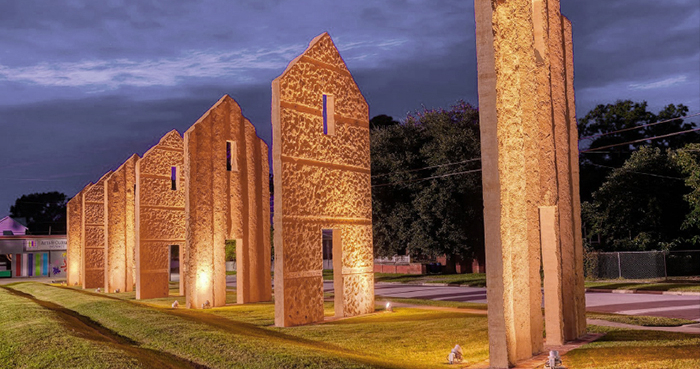
As we pull into town, we pass a mural of a giant stork that encompasses an entire block. There are galleries popping up here and there featuring the work of local artists. Standing amongst all this creativity and growth is Flue. Like Sayre’s other earthcasting work, Flue is stunning. It’s a sculpture in seven parts, with each piece crafted to look like the facade of a tobacco barn. Standing over three stories tall and weighing in at 280 tons, Flue is designed to make a statement.
To form Flue, Sayre cast reinforced concrete directly into molds cut into the earth here in Lenoir County – earth that once grew cotton, then tobacco. In fact, Flue was erected on the block where the Brooks Tobacco Warehouse once stood. When the town was in its golden leaf heyday, the building was a giant barn where rods upon rods of tobacco leaves hung, dried, and awaited processing. Flue is both the embodiment of this town’s history and its burgeoning path forward.
Like many of Sayre’s other sculptures, Flue invites visitors to interact with it. You can walk up to it, touch it, examine the textures. So I do just that. I enter the first doorway and start to walk in a straight line. There are seven doors before me and each offers a different view of the town. As I take a step forward, the vision of that town becomes a little bigger, a little clearer. Until I exit the last doorway and the point of Flue becomes obvious.
Since the sculpture was raised, the town has gone through a bit of a renaissance. There’s a motor lodge that has been renovated to look like it’s straight out of the 1960s. There’s a taproom and beer garden that are 100% solar-powered. There’s even a community of artists that have come to live and create in Kinston through the smART Kinston program.
All of this is proof that public art, like Flue, brings people together. It gives a town like Kinston a sense of place and attracts visitors like us. Perhaps it’s that, and not mere size, that’s the most monumental thing about Sayre’s work.