
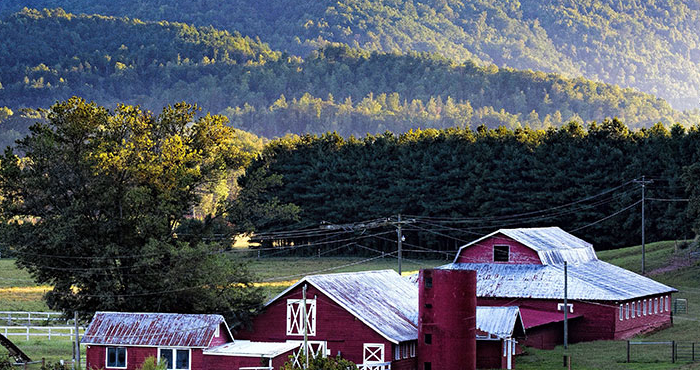
Step back in time to a world of quiet seclusion when you travel the backroads through the beautiful historic Happy Valley. It is as though the hurry of the modern world has not touched this natural wonder and historically rich valley on the banks of the Yadkin River. As you travel the scenic N.C. 268 byway, be sure to stop and experience the heritage and tradition of a bygone era. This valley was appropriately christened "Happy Valley" by its early settlers who described the valley as "a place of beauty, peace and tranquility" and the name aptly remains.
A mountain valley carved by the Yadkin River, Happy Valley is home to historic farms, winding country roads, and a place of joy and great beauty. Early settlers in Happy Valley were visionaries and entrepreneurs who farmed extensively, established schools, built churches and factories, and served in political positions in state and local government. Descendents of these families today still continue to stimulate the economy through aquaculture, tree farming, goat dairying, and cattle raising. Others look to the past, preserving traditions by working with draft animals, building traditional pole and log barns, and canning food. Always an eclectic area, Happy Valley is home to many artists, musicians, writers, and storytellers.
The centerpiece of the historic valley is Fort Defiance, the 1792 home of General William Lenoir, who became famous at the Battle of Kings Mountain in 1780. Today a fort in name only, William Lenoir’s home was built between 1788 and 1792 on the former fort site, which was designed to protect settlers from the early Native Americans in the area.
Considered one of the country’s most unique restorations, Fort Defiance features more than 300 pieces of furnishings and artifacts original to the home. Listed on the National Registry of Historic Places, the property includes the Lenoir family cemetery with graves dating back to 1785. The home is open for tours from April to October (Thursdays through Sundays) and weekends only and by appointment from November to March.
Another favorite stop is the Chapel of Rest. Situated on a knoll, the chapel is reminiscent of a simpler life, when locals lined the pews in their Sunday best clothing while listening to voices of worship rising to the rafters, with the Gothic Revival roofline above them. The Chapel is a restored Episcopal Church that served The Patterson School–presently a boarding and day school for grades nine through twelve. The chapel’s cemetery has graves dating back to around 1856 and is the final resting place of General Collett Leventhorpe, a well-known officer for the South during the Civil War. Open during daylight hours, the Chapel is a place to pause, meditate and enjoy the beautiful valley scenery.
Other popular stops along the historic Happy Valley route include:
- Tom Dooley Historic Tour and the grave of Laura Foster, both of which were made famous by the murderous legend and ballad, "The Ballad of Tom Dooley." The legend was made popular by the Kingston Trio who recorded the folk song in the 1950s. A driving tour CD and area map on the Tom Dooley legend can be purchased at the W. Kerr Scott Dam and Reservoir.
- Whippoorwill Academy and Village, a collection of log structures including a one-room school house, art gallery, Daniel Boone replica cabin, chapel, blacksmith shop, jailhouse, weaving room and cabin dedicated to the legend of Tom Dooley.
- W. Kerr Scott Dam and Reservoir, over 3,700 acres of state-owned recreational property. Activities include camping, hiking, swimming, boating, picnicking, fishing and mountain biking.
- Events like Plow Day, Mow Day, Living History Days, Colonial Christmas, Happy Valley Old-time Fiddlers’ Convention, and classical concerts at the Chapel of Rest promote an appreciation of traditional farming, history and music.