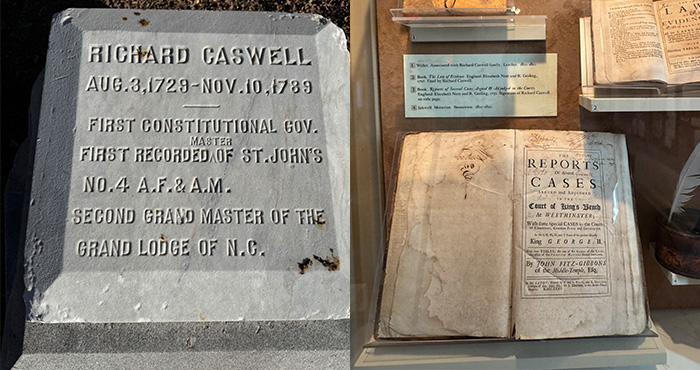
It’s a sunny day in Kinston, NC at a cemetery at Governor Richard Caswell State Historic site. Today is the day that the archeological students from East Carolina University have been waiting for. They all understand the historical significance of this moment. About 15 feet from the banks of the Neuse River a pile of red clay and sand protects the excavation site -a 5 ft x 7 ft hole with a depth of 6 ft. At the bottom clearly lies an outline of a dirt covered coffin. Onlookers watch as they carefully remove the lid of the coffin. Finding NOTHING. No body. No bones. No teeth. No valuables. Only sand and a mud encased piece of leather. Where is the body of Governor Richard Caswell?
Richard Caswell is one of Kinston’s most important historical figures. He was also a political pioneer for the state of North Carolina. He was born on August 3, 1729, in Baltimore, Maryland. At the age of 16, he relocated South with his family. During the Revolutionary War Caswell became a hero after the Battle of Moore’s Creek that ultimately withdrew the British from the Carolinas. Caswell became the first Governor of the independent North Carolina. He died from a stroke while presiding over Congress in Fayetteville on November 10th 1789. He was only sixty.
Upon his death there was a State funeral in Fayetteville. His body was brought back to his home in Kinston for burial, but the location of his grave has remained a mystery for centuries. Caswell, like other patriots, had lost much of his property during America’s Independence. Thus, experts believe the family had no money to purchase a tombstone for his grave.
Fast forward to the year 2000, when a group of Eastern Carolina University archeology students set out to solve the mystery. Driven by local legends and very few historical records, their search brought them to the Caswell family cemetery. This place was once on the grounds of the Red House Plantation of Governor Caswell. The students hoped that their search would uncover Caswell’s grave ending the years of mystery. But their search would not be easy because the Caswell cemetery was overgrown and had numerous unmarked graves. Working with their professor, Dr. Charles R. Ewen, the team used ground-penetrating radar to uncover hidden crypts, tunnels, and burials. Their search revealed a marked crypt of Caswell’s wife and child who died before him. Scans of the ground next to the crypt showed an unmarked grave. Was this the final resting place of Governor Caswell?
The excavation of the site revealed a coffin with no body inside. Now that the gravesite was found, there seemed to be even more questions. Why were there no bones? A man of Caswell’s status and rank would have had jewelry and medals buried with them. Where were they? Did someone steal his body? All the research and evidence strongly supports that Governor Caswell was buried at the Caswell Memorial Cemetery. In a time of high poverty, it was most likely graverobbers who took his body. They would have dug up Caswell in the middle of the night, taken him away, and stripped his corpse of any valuables–gold teeth, jewelry, or weaponry. Then his body would have been disposed of, most likely, dumped in the Neuse River. So, the search for Governor Caswell continues. Will you be the one who finds him?
Kinston is a town rich with history. The C.S.S. Neuse Museum has one of 4 ironclad battleships in the world. Area Military Parks and battlefields offer visitors a glimpse to how our nation was formed. The Governor Richard Caswell Memorial as mentioned above, explores the beginning of the independent state of North Carolina–minus a grave or two. In the end, visitors get to learn a little history and maybe make a little of their own.