
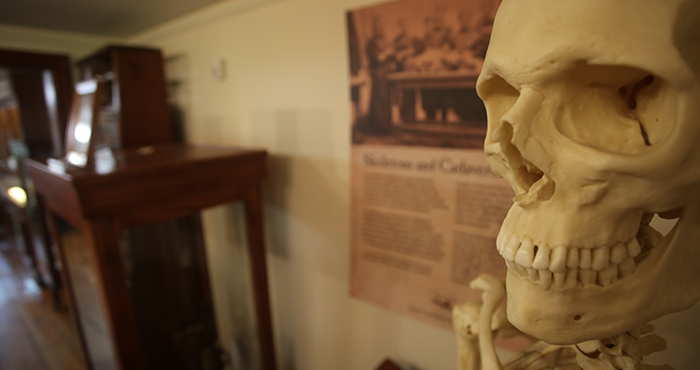
Museums are built to give you a deeper appreciation of the world around you. Art Museums tease you with colors and textures and ways to question the status quo. History museums tell you stories of the who, where and when in past tense. So, what do you think a medical museum in the little town of Bailey, North Carolina can do to change your view of the world? As it turns out, quite a lot.
From the road, The Country Doctor Museum is unassuming, blending easily into its surroundings. It’s just another tiny country house with a red metal roof and door to match. But, behind that door, are stories and items that are anything but typical.
Long before waiting rooms and insurance forms and co-pays, the country Doctor was the highest form of medical care. He would travel by buggy to your farm to fix what ails you. Broken bones, aches and pains, random rashes —they were all diagnosed and treated in the comfort of your home. What did all of this cost? There were no surprise emergency room bills with zeros to infinity. Most transactions were settled with a bushel of apples, a few pounds of ham and a little cash. Whatever was available. The job of a country doctor was to care for the people first and worry about payment later. Imagine that.
• • •
Walking into the Country Doctor Museum is kind of like opening your high school yearbook a century after graduating. There’s an appreciation of how far things have come. There’s also a lot of questions about what was acceptable at the time –like mullets.
The main building of the museum is quite small, but there’s a lot to take in. The Apothecary Room holds jar after jar of ingredients for medicines of the day. Powders. Leaves. Seeds. There’s Lotio Calamine Carbol, familiar to anyone who’s had a run-in with poison ivy. There’s Chamomile from dried flowers, used to dissolve gallstones. Then there’s Tamarind seeds imported from Jamaica to add a little sweet to your laxative and keep you regular.
During the 1800s, country doctors would make all the medicines themsleves. There was no running to the local CVS. If you could grow a garden, that was as good as a four-year degree in pharmacy. Each ingredient was collected, measured and ground by mortar and pestle. The resulting treatment was then rolled out and cut into pills. The shape and color of the pills often told the user what was safe to take. Round pills, good. Coffin-shaped pills, bad.
Confused? There are tour guides to help explain the process and a garden out back with flowers and plants typically used in the make-it-yourself pharmacy. A formulary index offers up treatments and recipes for everything from flatulence, to freckles and frostbite.
• • •
Going further into the museum you may notice a beautiful antique urn sitting on a glass cabinet. It’s the kind of piece that you may have in your own home, holding fresh flowers or a fragrant potpourri. But in this case, it’s made to hold leeches. A glass bowl in front of the piece contains some living samples. Swimming, swirling, waiting to take a sip on a passing vein.
Way back when, before germ theory was discovered, docs were very big on balancing out your "humors" with a good bloodletting. That involved cutting you at various places on your body and letting you bleed out into beautifully designed bowls until all humors were in equilibrium. When that didn’t work or if there was an infection, leeches were attached to finish the job. When they were full, they simply fell off. It’s like the patients were an all-you-can-eat Golden Corral buffet and the leeches had gotten their fill. Sadly, this story does not end with a chocolate fountain.
• • •
There are a lot of "what were they thinking?" moments throughout this museum. Especially as you dig more in the artifacts displayed in each room.
In one corner there is a civil war amputation saw with an ivory and tortoiseshell handle –beautifully designed, but impossible to sterilize.
Across the room, you’ll find a collection of prosthetic limbs. As it turns out, North Carolina was the first Confederate state to have a prosthetic limb program during the Civil War. The "leg" was designed with a permanent leather booth and attached to the user with a corset around the thigh and an over the shoulder pulley system. So, needless to say, you’re not getting through an airport scanner with that thing on today.
Down the hall you’ll find a full cabinet and carriage house of medical oddities. There are iron lungs for the treatment of polio. There are shelves of glass eyes you have to see to believe. There are ear horns waiting for you to hear their story. And under the label "The Scoop on Poop," you’ll find digestion aids including something called a rectal stretcher. But, (with one "t") we’re not going there today.
• • •
But you can. Plan your visit to the Country Doctor Museum and prepare to be entertained, prepare to be educated, prepare to be reminded and fascinated. Like any good museum, it will definitely change how you see the world. It will also make you less frustrated with insurance forms and full waiting rooms and the lack of leech therapy in modern medicine.
The Country Doctor Museum
7089 Peele Road
Bailey, NC 27807
(252) 235-4165
countrydoctormuseum.org