
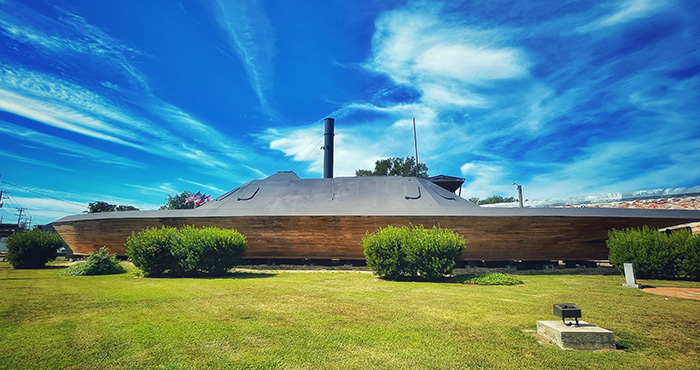
On the banks of the Neuse just past the Lenoir County Farmers Market stands a massive wooden warship greeting passersby on Herritage Street. If you’re wondering what in the world it’s doing there, simply climb aboard.
Inside the entrance a septuagenarian history buff dressed as a Civil War-era mariner is ready to spill all the details.
"This is the CSS Neuse II, the world’s only full-size replica of a Confederate Ironclad warship," he says. "With the boiler going, below decks there would be 135 degrees. It wasn’t well-lit, it was dark, filthy with coal dust, and crowded with 50 men on deck. The bathroom was a bucket."
Explore the 158-foot-long, 34-foot-wide ship and discover a locomotive boiler below as well as where the cannons and crew lived. The history-guide is right, it is hot below deck, not 135 degrees, but hot enough to make the outside breeze seem welcome.
So why build a full-size replica of the Neuse II? That’s part tall tale, all history, but the one thing agreed upon is that the gunship never made it more than a half-mile from where the replica now sits.
Commissioned by the Confederate Army in 1862, the original Neuse II was built in nearby Seven Springs, about 18 miles from Kinston. Its construction was halted later that year when the Union army came through Whitehall and burned the building materials. Undaunted by the setback, construction began again and in 1863, it traveled downstream to Kinston where it was to be fitted with the locomotive engine, iron plates for the hull, cannons, and guns easily accessible from the town’s railroad system.
A year later in the spring of 1864, sitting in a cathole off the shores of town, construction was not quite finished when the CSS Neuse II was called to help take back New Bern. Unfortunately, it only made it about a half-mile down river before it became stuck on a sandbar. The quest to New Bern was abandoned as the crew could only wait for the river to rise again to free it. A month later, the river rose with the rainfall and the Neuse II came back into its moorings in Kinston.
Its final mission came in March of 1865. Captain Joseph Pierce and his crew manned the Neuse II to provide cover for retreating Confederate troops before allegedly scuttling the ship to prevent it from falling into Union hands. This end of the war effort would be the ship’s legacy as it sat on the bottom of the Neuse River for nearly 100 years.
Though the machinery, armor plating, and guns were salvaged at the end of the Civil War, the gunboat itself was left where it was. In the early 1960s, the remains of the hull were moved to the Richard Caswell Memorial Park. Today, the hull is the centerpiece of the CSS Neuse and Governor Caswell Memorial Historic Site on N. Queen Street in Kinston (about a block from the replica). This museum is well worth the trip to see the hull remains laid bare like a skeleton, the remaining bones of a Civil War gunship that never quite saw the action for which it was built.
As the historian/mariner at the replica would say, "The design was good, but it was a little bit too much for this river."