
Husband: Honey, I’m home. I’m starved. What’s for dinner?
Wife: Catfish.
Husband: Catfish? Again? That’s 10 nights in a row.
Wife: Then next time don’t catch one that weighs 143 pounds.
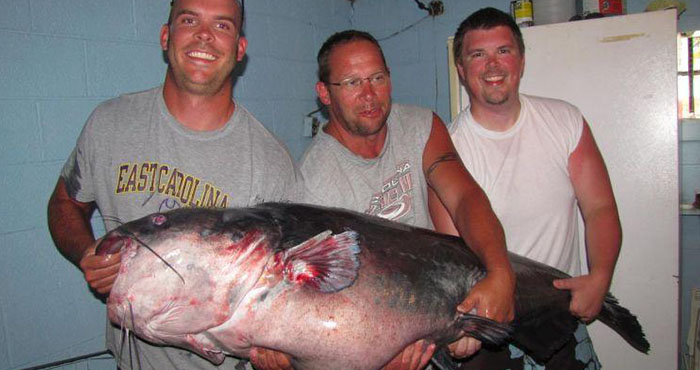
Such might be the conversation in the Anderson house down in North Carolina. Nick Anderson, of Greenville, N.C., recently caught a 143-pound blue catfish in Buggs Island Lake. Buggs Island, also known as Kerr Reservoir, borders both Virginia and North Carolina, but Virginia will be credited with what appears to be a world-record catfish caught on hook and line.
The monster fish, landed after a 45-minute war, measured 57 inches in length with a belly that would require a 43.5-inch belt. The fish not only set a new record, it obliterated the previous standard of 109 pounds, established back in March by Tony Milam, who also caught his big catfish in Buggs Island Lake.
There is little doubt, now, that Buggs Island Lake is the go-to destination for trophy catfish. Expect this fish to create a buzz up and down the eastern seaboard and bring tourists from near and far to Virginia waters.
Buggs Island is a natural when it comes to growing big fish. The lake is jam-packed with shad and baitfish, it is relatively clean and has lots of deep channels where big catfish like to hang out.
Blue catfish are generally that — a pale blue in color with a deeply forked tail. The species is distributed from Minnesota and Ohio southward into Mexico. In Virginia, it occupies both fresh and brackish water. The blue cat is an aggressive feeder, preferring other fishes and crawfish in its diet. It likes clear, clean water and a little current. It is easily the largest of the American catfish, though sometimes rivaled by the flathead catfish.
Flathead catfish are recent introductions in Virginia waters. Native to the Mississippi Valley, the Game Department thought the big, aggressive fish would add excitement to the trophy fish menu in Virginia. And they have, but many fishermen feel that the super-aggressive flatheads may be eating too many smallmouth bass in rivers like the James. Studies show, however, that most of the fish eaten by flatheads are ordinary suckers. Suckers hang near the bottom of the rivers and are relatively easy to chase down. Flathead catfish can push 100 pounds, but no one has ever landed one that large on hook and line. That doesn’t mean they are not out there, however.
Flathead catfish are generally a dirty brown in color. Their heads look like a truck drove over them and smashed them in. Thus the name, flatheads.
The third major catfish in Virginia waters is the channel catfish. Compared to their larger cousins — the blue and flathead catfish — channel cats are practically minnows. They average about 5 pounds, 10-pounders are considered nice fish and a 20-pounder is a monster. That 143-pound blue catfish could actually eat a 20-pound channel catfish – though I expect it would have ended up with a good case of indigestion.
Well, Virginians, there is a holiday coming up. Why not go out and try to catch a catfish bigger than 143 pounds? Good luck with that.
Fishing tips
While we’re on the subject, what’s the best way to fish for catfish? Here are a few tips I have.
Catfish will eat almost anything, but the misconception is that they like rotten, stinking baits. That’s simply not true. They prefer fresh baits — shrimp, minnows, fresh chicken livers, and fresh cut bait, especially shad. A common mistake of those fishing for catfish is they don’t change baits often enough.
If you are fishing for catfish during the day, find the channel of the lake or river you are on and fish there, particularly where the channel begins to drop off. But if you fish at night for catfish, fish shallow water. Catfish often come right to the bank at night, so why cast your bait out to 100 feet where they used to be?
Finally, use some serious equipment. Who knows when a 100-pounder will snatch your bait, and if that happens, you’ll need a powerful rod and reel.